Resource guarding occurs when a dog fears that a valued resource may be taken away. Dogs may guard food, bowls, chews, toys, stolen objects, resting spaces, people, or even seemingly random items.
Guarding is not a battle for control, and it should not be treated as disobedience. The dog is communicating discomfort and trying to create distance.
Our goal is not to prove that we can take things away. Our goal is to teach the dog:
Humans approaching means good things happen, and giving something up is safe.
Recognizing Resource Guarding
Resource guarding may include:
Freezing or becoming suddenly still
Lowering the head over an item
Hovering, covering, or blocking access
Eating faster when someone approaches
Hard staring or showing the whites of the eyes
Carrying an item away
Stiffening, growling, snarling, snapping, or biting
Leaving the item to confront an approaching person or animal
Growling is valuable information. Never punish a dog for growling. Punishing the dog for the warning may stop the dog from communicating before escalating to a bite.
Management First, Training Second
Management prevents conflict and stops the dog from repeatedly practicing guarding behavior.
For now:
Feed the dog separately, behind a closed door or secure barrier.
Keep children and other animals away while the dog is eating.
Do not allow animals to share food, bowls, chews, bones, stuffed toys, food puzzles, or lick mats.
Pick up high-value items before dogs are together.
Do not free-feed unless specifically instructed.
Do not approach, touch, or reach into the dog’s bowl while the dog is eating.
Do not chase the dog for stolen objects.
Do not grab the dog’s collar or reach into the dog’s mouth.
Do not corner the dog or physically force an item away.
Do not deliberately test whether the dog will guard.
Create a Predictable Feeding Routine
The dog should have a designated feeding location where they can eat without being monitored or disturbed.
Place the food down, allow the dog to enter the feeding space, and close the barrier. Give the dog enough time to finish eating and move away from the bowl independently.
Pick up the bowl only after the dog has left the feeding area and is safely separated from it.
A dog that waits to eat until people leave may be communicating that eating feels vulnerable. Giving the dog privacy is appropriate. We do not need to stand nearby or pressure the dog to eat in our presence.
Foundation Skills
These skills should first be taught away from guarded resources.
Trade
“Trade” means releasing an item in exchange for something better.
Begin with a low-value toy the dog does not guard.
Allow the dog to hold the item.
Present a high-value treat.
When the dog releases the item, mark and reward.
Whenever it is safe, return the original item.
Returning the item teaches the dog that releasing something does not always mean losing it forever.
Do not begin trade training with a highly valued item or an object the dog has previously guarded. Keep the treats tiny so they eat them in one bite.
Back
“Back” asks the dog to move away from an item or area.
Teach this without food bowls or guarded objects present. Reward one small step backward and gradually build additional distance.
This skill can eventually help create safe space before an item is picked up.
Find It / Get It
“Find it” means food will be scattered away from the resource.
This can help the dog disengage, move away, and lower arousal. Practice it regularly when no guarding is occurring so it has a strong, positive history.
Out
“Out” may be used for releasing toys during cooperative play. It should be taught through exchanges, not pressure or confrontation.
Keep cues simple and consistent. Avoid repeatedly saying “no,” grabbing the object, or demanding that the dog release something without offering a safe alternative.
Training Exercise One: Human Approaches Predict Good Things
This is called counterconditioning. We are changing how the dog feels about approaching people.
Begin with a low-value resource and at a distance where the dog remains completely relaxed.
Allow the dog to interact with the item.
Approach only as close as the dog is comfortable.
Toss a high-value treat toward the dog or resource.
Immediately move away.
Repeat a few times and end the session.
The pattern should be:
Person approaches → excellent food appears → person leaves.
Over time, the dog should begin to look pleased when the person approaches, rather than becoming worried or defensive.
Progress may include:
Standing at a distance and tossing treats.
Taking one step closer before tossing.
Walking past and tossing a treat.
Pausing briefly near the area.
Adding something better to the bowl from a safe distance.
Picking up the bowl or messing with the food while the dog is eating is never required. The goal is emotional safety, not proving that the dog will tolerate annoyances.
Training Exercise Two: Teach an Alternative Behavior
We can also teach the dog what to do when a person approaches.
This is called differential reinforcement of an incompatible behavior. The dog is reinforced for performing a behavior that is incompatible with hovering over or defending the resource.
Possible behaviors include:
Raising the head away from the bowl
Backing away
Moving to a bed or station
Touching the handler’s hand
Turning away from the item
First, teach the behavior in a neutral environment.
Once the dog performs it easily, introduce an empty bowl or neutral object. Approach from a comfortable distance, cue the behavior, and reward the dog away from the object.
Gradually increase the challenge under professional guidance.
Empty bowl
Neutral object
A few pieces of low-value food
Low-value toy
Moderately valued item
Part of a meal
Full Meal
Higher-value items
Change only one part of the exercise at a time. Do not increase the value of the item while also moving significantly closer.
Watch the Dog, Not the Checklist
Continue only while the dog remains comfortable.
Positive signs include:
Loose, relaxed body
Normal eating speed
Soft eyes and facial muscles
Looking toward the person in anticipation of the treat
Easily moving away from the item
Happily performing the trained behavior
Stop and make the exercise easier if the dog:
Freezes
Hovers over the item
Hard-stares
Eats faster
Stops eating
Refuses to move away
Growls, snarls, snaps, or lunges
Leaves the item to confront the person
These behaviors mean the item is too valuable, the person is too close, or the exercise progressed too quickly.
Emergency Retrieval
If the dog obtains something unsafe:
Do not chase, grab, corner, or confront the dog.
Move other animals and people away.
Use “find it” or scatter several high-value treats away from the item.
Allow the dog to move away.
Use a gate, door, or second person to prevent the dog from returning.
Pick up the object only after the dog is safely separated.
If the dog has swallowed something toxic, sharp, obstructive, or otherwise dangerous, contact a veterinarian or poison control immediately. Do not risk getting bitten.
Higher-Risk Resource Guarding
Some cases require especially careful management and professional support.
Higher-risk behaviors include:
Guarding locations, furniture, people, or random objects
Guarding items the dog does not currently possess
Attacking another dog for approaching an object several feet away
Leaving the resource to charge or attack
Showing an intense response to a casual approach
Biting with little or no observable warning
Guarding from children
Causing puncture wounds
Guarding multiple categories of resources
Becoming increasingly unpredictable
These cases are not hopeless, but the prognosis is more variable. Triggers may be difficult to predict or reproduce safely, and mistakes may carry a significant bite risk.
The realistic goal may include substantial behavioral improvement combined with long-term management.
Veterinary Support
Pain, dental discomfort, digestive problems, hunger, cognitive changes, medication effects, or other medical conditions may contribute to guarding or irritability.
A veterinary evaluation is especially important when:
Guarding begins suddenly
The behavior rapidly intensifies
The dog also guards body space or reacts to touch
Appetite, digestion, mobility, sleep, or behavior has changed
The aggression appears unusually intense or unpredictable
Medication may be appropriate when anxiety, impulsivity, or arousal prevents the dog from safely participating in training.
Training Reminders
Keep sessions brief.
End while the dog is successful.
Begin each session at an easy level.
Use food that is more valuable than the item involved.
Never train around children or uncontrolled animals.
Do not practice with very high-value resources without professional guidance.
Progress according to the dog’s body language, not according to a timeline.
Management remains important even as behavior improves.
Resource guarding is an emotional and safety issue. Thoughtful management protects everyone while training helps the dog build trust, predictability, and safer responses.
By Aubrey Whitten, CBCC-KA | Founder, Beezy’s Pack
Bringing home a new puppy is an exciting and meaningful decision that comes with joy and responsibility. At Beezy’s Pack, we specialize in helping families prepare for and navigate the early stages of canine development using evidence-based, humane training practices. As a certified canine behavior consultant, I often work with clients eager to do things right from the start but aren’t always sure where to begin.
This post is designed to help you understand what to expect and how to prepare when you’re welcoming a new puppy into your home. If you’ve already selected a dog that fits your lifestyle well, this guide will walk you through the next critical steps—before your puppy even sets foot through the door.
Step One: Prepare the Environment
Before bringing your puppy home, creating a safe and structured environment that supports calm behavior and learning is essential. Puppies are highly impressionable; the first few days and weeks are foundational for long-term success.
Create a Designated Puppy Zone
Set up a designated area in your home that allows your puppy to rest, explore safely, and begin to learn boundaries. This might include a crate, an exercise pen, or a gated-off section of a room. The space should be free from hazards and overstimulation and offer opportunities for rest and low-pressure exploration.
Puppy-Proof Your Space
Secure loose cords, move toxic plants and cleaning supplies out of reach, and remove any small items a curious puppy might chew or swallow. Consider this the canine version of baby-proofing.
Stock Up on the Right Tools
There are a number of products that can help support healthy behavior and reduce stress during this transition period. I’ve compiled a list of recommended items—training tools, enrichment toys, crate setups, teething solutions, and more—on our Amazon affiliate list, which you can access here: View the Amazon Puppy Prep List
These are all tools I’ve personally used or recommended to clients as part of a well-rounded behavior plan.
Step Two: Set Realistic Expectations
One of the most common mistakes new puppy parents make is assuming that a puppy will quickly settle into the home without confusion or distress. In reality, even the most well-matched puppy will experience a period of adjustment.
Adjustment Takes Time
It’s common for puppies to experience fear, overexcitement, or difficulty settling during the first few days. House training is a process. So is crate training. So is sleeping through the night. Progress is rarely linear—and that’s okay.
Sleep is Critical
Puppies need 18 to 20 hours of sleep per day. Overexposure to stimuli, too much activity, or unpredictable routines can lead to cranky, overstimulated puppies more prone to biting, barking, and stress-related behaviors.
Training Should Be Developmentally Appropriate
Early training is not about strict obedience—it’s about gentle exposure, play-based learning, building positive associations, and beginning to communicate clearly. Avoid punishment or dominance-based methods, which can increase fear and damage your relationship.
Step Three: Establish a Routine
Predictability helps puppies feel secure. While your schedule doesn’t need to be rigid, having a consistent daily rhythm will reduce stress for you and your puppy. A solid routine includes:
Scheduled feeding times
Regular potty breaks (every 1–2 hours for young puppies)
Short, structured training sessions
Age-appropriate enrichment and play
Frequent rest periods throughout the day
Step Four: Build Your Support System
No matter how prepared you are, raising a puppy can feel overwhelming at times. Access to accurate, evidence-based support makes a significant difference.
At Beezy’s Pack, we offer:
Private puppy training consultations (in-person and virtual)
Guidance on crate and house training
Support for common puppy behaviors like nipping, jumping, and chewing
Custom enrichment plans
Ongoing behavior support as your puppy grows
We also offer a free downloadable Puppy Starter Guide and regularly share training videos and resources via our website and Instagram account.
Final Thoughts
Raising a puppy isn’t about perfection—it’s about building a thoughtful foundation and responding to your dog’s needs with clarity, compassion, and consistency. If you prepare intentionally, avoid rushing the process, and focus on creating a calm, predictable environment, you’ll be well on your way to raising a confident, well-adjusted adult dog.
If you’re preparing to bring home a new puppy and want professional guidance, visit www.beezyspack.com to learn more about our training programs and behavior services.
Your puppy’s success starts with how you show up for them from day one.
No significant differences in bite severity were observed between contexts.
Male victims were more numerous across all bite contexts.
Only the age of the victim was predictive of bite severity: adults were bitten more severely than infants and infants more severely than children.
Children and infants were considerably more common victims than adults. Most bites were to the limbs, followed by bites to the face and neck area. Bites to the face and neck area were more common among children and infants, which is also consistent with earlier reports.1,10,11,27 (Numbers refer to references in the essay.)
Non-neutral dog body posture and some displacement and appeasement behaviors increased approximately 20 seconds before the bite and humans made more tactile contact with dogs 21 seconds before the bite.
From nine seconds before the bite, more codes for movement away from the dog were noted.
Bites during play and benign interactions were particularly common, as reported before.10,14,16,18,24,50 (Numbers refer to references in the essay).
Standing over a dog, petting, and restraining a dog were seen proportionally more frequently closer to the bite, increasing approximately 20–30 seconds before.
The issue of dog bites and dog aggression directed at humans is frequently in the media. However, scientific research and evidence on the subject is scattered and sparse. Public and political opinions are often misinformed and out of proportion to the extent of the problem. Dog Bites brings together expert knowledge of the current situation, from a wide variety of disciplines, to provide information to the many people and professions affected by this issue. Subjects range from the practical, medical, behavioural, sociological, and theoretical, but the overall approach of the book is objective and integrative. Topics addressed include: the genetic basis of aggression; the public image of aggressive dogs; bite statistics; risk factors; the forensics and surgical aspects of dog bites; international legal perspectives; court evidence; first aid treatment; zoonotic disease potential; behavioural rehabilitation options; the risk to children; and a consideration of why some dogs kill. All contributors are academic or long-standing professional experts in their field, and they represent a wide spread of international expertise. This issue is an important one for pet owners, vets, animal shelters, and anyone who works with dogs, such as the police. This book will be a valuable resource for them, as well as for animal behaviourists, academic researchers, health professionals, dog breeders, and handlers. *** “… the first comprehensive resource on the subject of dog bites… The overall intent of the book is to prevent dog bites. …does a good job of compiling the information we think we know about dog bites into one place. It also debunks much of what were previously accepted truths about dog bites to humans. In the final chapter, the editors state they hope that ‘highlighting the many deficiencies in our understanding will inspire rather than demoralize’ and that they ‘have offered a point of reference not just to the problems but also the solutions'”. —Journal of the American Veterinary Medical Association, Vol. 252, No. 6, March 15, 2018 [Subject: Veterinary Science, Public Policy, Animal Behavior, Animal Policing]
THE COMPLETE GUIDE TO UNDERSTANDING & GUIDING YOUR REACTIVE DOG
This guidebook will assist you in working with and supporting your dog through their reactions. A reaction is based in emotion, as we discussed above… so it is important to act as your dog’s guide so that you can increase their confidence and their resilience.
Just like us humans, dogs can react to certain things (aka stimulus) in their environments. The reaction can depend on many factors, including novelty, emotion, and proximity. These reactions can sometimes reflect BIG emotions, also known as arousal. Arousal can lead our dog to excitement, and eventually to frustration. Our dog’s can also be experiencing fear, pain, or discomfort — which will greatly change how they interact with the world (and the stimulus) around them.
Dog’s generally will respond to stimulus in their environment in four ways. The fight / flight / freeze / flirt response in your dog might look like any of the following behaviors:
Focusing on the stimulus for more than 2-3 seconds
Body stiffens, also known as a freeze response
Barking, lunging, or moving towards the stimulus
Cowering, hiding, running away, or making themselves appear small
Jumping up and biting the leash or the handler out of frustration
Redirected bites to the handler
There is a good amount of reasoning behind your dog’s reactions. Let’s keep in mind the LEGS model…
LEARNING – Dogs learn by association, just like we do. Have you ever met someone who came up in your personal bubble, greeted you rudely, or gave you a bad gut feeling? You would use this situation to learn to steer clear of similar interactions with this person in the future… you might even use a tactic to get the person to steer clear of you, or to create distance between you both. Trauma also falls under this category.
ENVIRONMENT – What is your dog’s day-to-day life like? Are their needs being met? Meeting your dog’s needs goes way beyond neighborhood walks and basic affection. They need routine, predictable patterns, and enrichment.
GENETICS – Your dog has been bred for thousands of years for a very specific purpose! It is only recently that many of these breeds are becoming house pets. Some dogs are predisposed to stranger danger… some dogs have been bred to chase after, control, and bite at moving things…
SELF – Your dog is a unique individual! Factors can include age, health, and individual personality. Pain is a big source of overreactions in dogs, that often gets overlooked.
MANTRAS FOR REACTIVE DOGS
Reactive dogs are not bad dogs.
Reactive dogs need additional guidance, not additional corrections.
Reactive dogs are having a hard time, not giving you a hard time.
UNDERSTANDING REACTIVITY: THE TRUTHS
Reactivity occurs when a dog displays action or behavior that coincides with its feelings about a specific trigger or situation.
This can mean reacting in ways such as barking and/or lunging towards the trigger(s).
Trigger stacking can occur when a dog is overstimulated by more than one trigger at a time, or one right after another.
Reactivity happens when a dog’s emotions display themselves outwardly.
Reactivity can stem from a place of fear and insecurity.
Reactivity can happen when on-leash excitement turns into frustration, and frustration levels can vary between various dogs and breeds.
In order to fully understand your dog’s reactivity, you must understand the following…
THE UNDERLYING EMOTIONS AT PLAY
Fight vs. Flight – if we take away a dog’s option to FLEE by putting them on a leash to take them for a walk… they may learn that their only option is to FIGHT.
HOW EMOTIONS AFFECT BEHAVIOR
Behavior is the way in which an animal or person acts in response to a particular situation or stimulus.
Behavior is based on feedback.
HOW OUR PROVIDED FEEDBACK AFFECTS EMOTIONS AND BEHAVIORS
What are we feeling? Energy is emotion and intention.
SO HOW DO WE BEGIN TO HELP OUR REACTIVE DOG?
Look at That (LAT) Training
Developed by Leslie McDevitt
LAT OVERVIEW
Why this is useful for your dog to know: Some dogs go ballistic (barking, lunging and generally freaking out) on leash when they see something exciting or scary. Although a lot of dogs display reactive behavior, it can be embarrassing at best and dangerous at worst. Implementing this “look at that” training plan will help dogs stay calm and safe in these situations.
End behavior: The dog will look at the trigger (whatever she is reactive toward) and then look back at the handler.
Step 1: Decide on a sound, word or visual marker that you’ll use to indicate to your dog that she’s doing something great and a treat will follow. Clickers and a verbal “yes” or “good” are popular markers.
Step 2: To teach your dog that the marker always means a treat is coming, click the clicker or say the word and then give her a treat immediately. Do this repeatedly, until she looks expectantly at you whenever you use the marker.
Step 3: Next, with the dog on leash, stand at a distance from the trigger. You should be far enough away that your dog sees her trigger but isn’t reacting. As soon as she looks at the trigger, use your marker. She should turn toward you in anticipation of the treat. When she does, give her the treat. Repeat 10-15 times.
Step 4: When she consistently looks at her trigger without reacting, test to see if she’ll look back at you in anticipation of the marker and treat after she looks at her trigger. If so, mark and then treat. If not, repeat the previous step.
Step 5: Gradually, one foot at a time, decrease the distance between your dog and the trigger. Continue using your marker and treats if she doesn’t react. You may have to shift between Steps 3 and 4 as the distance decreases.
PROOFING: Proofing means teaching the dog to generalize the behavior in different contexts. It’s important to practice LAT often with your dog. When you first start, you will want to practice in the same environment, someplace that is low-stress for your dog. If your dog is reactive toward other dogs, make sure that you are practicing with a calm, non-reactive dog as the trigger.
BAT helps animals gain confidence and social skills. BAT is a natural method that creates an emotionally safe interaction with minimal intrusion. BAT is especially useful when the “triggers” for frustration, aggression, or fear are living beings, for example when dogs bark at or bite other dogs or people.
Ha the 80’s… So nostalgic of the eighties. Finishing High School, starting University, the best and the worst music of the past 50 years. Speaking of the things we are not missing: mullets and pony tails (I am so sorry mother, everybody was doing it…), parachute pants and stonewashed jeans (please don’t tell me they are coming back), shoulder pads, blue eye shadow, and punitive/coercive dog training methods…
The 90’s were refreshing. We started the Decade of the Brain (the new fixation and obsession with neuroscience), started to focus on dogs as genuine research subjects, and indulged in pretty radical re-thinking of everything having to do with dogs and wolves. A lot of good came out of the 90’s. But a lot of myths were also created. It was also the start of a new appreciation for science in general. Popularization of science and knowledge translation became the focus of some scientists. Some did it well. Very well. Others confused popularization with oversimplifying and polarizing issues between “right” and “wrong”, and encouraged the idea of a “truth” and the wrong idea that science is about “facts” or about “proving” things.
Let’s examine some of those ideas. First, science does NOT prove anything. Science can only be “quite sure” (at best) about something. Mathematics (a tool of science) can offer “proofs”, but the scientific process itself is not about proving anything. It does not matter if you used null hypothesis significance testing, Bayesian statistics, or any other method. If there is one thing we know about research as scientists, it is about what we are not 100% sure about. Unfortunately some scientists and non-scientists want to be convincing, and use very strong language to make their points. Many would defend that strategy by arguing that they have to convince trainers that they are doing it wrong. It seems that there is a new movement now going to rectify some of those created myths and misunderstandings. Some of us engaged in some of these comments (e.g., Roger Abrantes, Marc Bekoff, Monique Udell, myself) are often getting criticized for appearing to go against the current. Interestingly, from a scientific perspective, we are with the current. I will expand on this below.
One thing that plagues the knowledge translation process in canine science is the fact that the public has access mostly to books (albeit written by scientists). A little known fact is that most scientists don’t write books (or blog posts, or Facebook comments)… They write scientific papers, present posters and give talks to peers at scientific conferences. Why? Because many, if not most, are not interested in sharing with the public what they do. They do not have the time to write books, because, after all, peer-reviewed papers, not books, will get you tenure, other promotions, and scientific funding. The result is interesting: Most non-scientists in the dog world have a very biased perspective of who is actually well-known in the canid science world. They will name Coppinger, Klinghammer, Miklósi, Mech, etc. (all truly great scientists, for the record, along with some much less well known ones in scientific circles), and overlook other giants in the field. It always baffles me that individuals interested in wolves do not know Carbyn, Fentress, Frank, Ginsburg, Harrington, Moran, Murie, Paquet, Peterson, Pimlott, Zimen, and so many others that are unavoidable contributors of the field (in number of publications as much as scientific contributions and reputation). Although most of them have not written books, or at least not after the 90’s, they have undeniable clout in the field of wolf research (one of my PhD supervisors, John Fentress, is finishing a book as I write this).
So what are examples of confusions that arose from some popularized canine science? Here is a short list of myths. Let me just comment right away that anybody I know that a) actually worked with wolves or studied animal learning, and, b) actually read the scientific papers, would not make the statements below:
1. Punishment does not work and is always cruel. 2. Dominance does not exist in wolves. 3. Dog evolution has nothing to do with wolves.
There is quite a bit to say on each of these items. Note also that, on purpose, the statements are very black or white. In fact, especially with the corrections, clarifications, and even retractions of the past few years from some individuals, many of you will think I am unfairly dramatic. Well, I agree to some extent, but considering what I read on Facebook and elsewhere, this is at least the “dark” end of the spectrum.
You see, science is about shades of grey. Science seeks a consensus. Science seeks converging evidence. That rarely translates into “black or white” statements. Science is about synthesis, open-mindedness, even compromises. Pitting theories against each other is part of the process. But the point is to get to a golden middle. To that idealized “truth” that some promise you. Regardless of what they say, scientists are idealists (and human). Sometimes they get carried away by their convictions and opinions. My father gave me a gift early in my life as a young scientist. In the 50’s, he was a graduate student of Jean Piaget at La Sorbonne. From what I understand, my father struggled very much in trying to reconcile North American and Continental European psychologies. In the process though, he became quite a dialectician, something he taught me through his careful consideration of any argument I would try to make or idea I would put forward (although I was not fully aware of it at the time). The process is simple: State a thesis (e.g., “punishment does not work”). Find the “evidence” for it, argue for that point. Then, state the antithesis (e.g., “punishment works”). Same process, gather the data, argue for that point. Finally, and most importantly, formulate the synthesis. It likely won’t be black (thesis) or white (antithesis), it will be something in the middle, in the shades of grey. His gift was to teach me to be a relativist and never accept dogmatism, in science, or in anything else in life.
Very quickly, the statement, “punishment does not work”, is easy to deconstruct. Obviously (and sadly) punishment (mostly) works. If any of you try to use science to make the statement “punishment does not work”, you are in trouble. There are literally thousands of scientific papers and hundreds of scientific books (e.g., the classic Handbook on Operant Conditioning, Honig & Staddon, 1977; Domjan, 2003*) that will confirm this: Using punishment can suppress, if not inhibit completely, behaviours (it is, after all, the definition of the term). The question in this case is about the statement itself. The statement misses the point: What are the side-effects of punishment? That is the question! And as I often argue, then we fall into ethical arguments more so than scientific ones. I often find scientists and dog trainers not courageous enough in just making an ethical statement. My approach is to ask the question “what kind of relationship do you want with your dog, one based on coercive and punitive interactions, or one based on friendship, communication and mutual understanding?”. There is another important issue associated with the arguments against punishment. Not all punishment is “punitive” and coercive. The scientific definition simply suggests that a punishment will at least reduce the frequency (count per unit of time), duration or intensity of a behaviour. Nothing here suggests the necessity of using shocks, or hitting, kicking, yelling, etc. Somehow, the connotation of the scientific term took a dark turn.
Any student in experimental psychology has done at least one cognitive computer task where the computer gives feedback for accurate (sound A) or inaccurate (sound B) responses. This is typically done so the subject can update its knowledge of the task and change its response pattern to increase performance. Is it not fascinating that the same idea will repulse many trainers? The idea of saying (softly) “no”, or “nuh uh” or use a non-reward marker (a very fancy terminology to say “punishment”) seems to get people all up-in-arms. Why? Well, technically, if “no” means “that was not the right choice” or “don’t do that again”, and the dog does not repeat the behaviour… it was a punishment. It is actually what I like to call information. Simple. We like information as humans, because it accelerates learning, it helps us make sense of the world, it helps us make sense of a set of rules in a game. When I was learning classical guitar in the 70’s, I was very happy to have my teacher tell me what I was doing right, and what I was doing wrong. It was less frustrating to know about my mistakes, than trying to guess what I was doing wrong. He was paid to tell me this. Why do we deprive our dogs of that information? In my lab we work a lot with border collies. I have seen border collies go nuts if they are told only what they do right, and are ignored when making a wrong choice (for example, in a matching-to-sample task). In fact, ignoring wrong responses becomes very aversive, without really telling the dog what to avoid doing. Interesting, is it not? That will sound familiar. Positive reinforcement-only trainers will often make the argument that punishment won’t tell the dog what to do. Mmmh… that’s right… but it won’t tell the dog what to avoid doing either. This becomes very obvious in some complex tasks with multiple choices, meaning multiple possible mistakes or misses. But again, you are not “punishing” (with the modern, non-scientific connotation), you are informing.
To summarize this discussion on punishment:
1. Punishment works… but if punitive and coercive, it does not make it good or ethical.
2. Punishment is not necessarily punitive or coercive.
3. Information (feedback) about good choices (positive feedback) and mistakes (negative feedback) accelerates learning and decreases frustration… even if technically the negative feedback part, by definition, is “punishment” (as it gets the dogs to reduce or eliminate responses).
As for dominance… ugh… what a mess that one is… and the confusion between dominance (as status vs. as a trait), dominance hierarchies, aggression, aggressiveness, agonistic behaviours, rank, status, etc. People citing papers that are supposed to reject the dominance concept when they actually simply redefine the alpha role (not roll) and in fact even suggest parents have a firm hold on the pups (i.e., being quite disciplinarians)… yes, that Mech paper (1999). The same author that more recently published on dominance in wolves (e.g., Mech, 1999; Mech, 2000; Peterson, Jacobs, Drummer, Mech, Smith, 2002) because he actually never denied the existence of dominance hierarchies, and the same author that writes to Marc Bekoff about Bekoff’s great piece “Social Dominance Is Not a Myth: Wolves, Dogs, and Other Animals” published in another blog platform in February of 2012: “… a quick scan of the (name removed) article reveals much misinformation attributed to me. This misinterpretation and total misinformation like (name removed)’s has plagued me for years now. I do not in any way reject the notion of dominance.”
In an online essay by Mech, he also writes “Similarly, pups are subordinate to both parents and to older siblings, yet they are fed preferentially by the parents, and even by their older (dominant) siblings (Mech et al. 1999). On the other hand, parents both dominate older offspring and restrict their food intake when food is scarce, feeding pups instead. Thus, the most practical effect of social dominance is to allow the dominant individual the choice of to whom to allot food.” Ironically, Mech pointed towards more tension between the breeding male and the breeding female, or between parents and progeny, than I believe we ever saw or documented at the Canadian Centre for Wolf Research (a captive pack in a 4 hectare enclosure; e.g., Fentress et al, 1987; Gadbois, 2002). So much for the idea that captive wolves are more likely to show dominance than wild ones! I am still waiting for the evidence (actual data) suggesting that captive wolves are more stressed than wild ones. So far, I see only the opposite trend, or no difference at all.
For my part, I adhere at least partially to “role theory”, proposed by scientists like Bernstein, Fedigan, Gartland, and Mech (Mech, 1999 writes about “division of labour”, a similar concept). In wolves, it is clear that the dominance hierarchy is in place to determine the breeding pair (as only the formerly labelled “alpha male” and “alpha female” typically breed; wolves are “technically” monogamous). This is clearly seen via noticeable peaks in aggression in (captive and wild) packs during the breeding season (January to March). Our main captive pack at the Canadian Centre for Wolf Research rarely displayed significant aggression or dominance conflicts outside of the breeding season (with some exceptions over the 30 year life of that pack). And even during the breeding season, my Master’s student Barbara Molnar re-analyzed my PhD videotapes to find that they still engaged in almost 3 times more affiliative behaviours (e.g., play) than agonistic behaviours during that more “conflictual” time of year!
We also forget that not all packs (captive or wild) are the same. Some form nuclear family groups (mom, dad, pups of the year). In those groups you are less likely to find any dominance hierarchy. Why? Well, for one, wolves don’t “enter” the dominance hierarchy until they are sexually mature (at puberty). In principle this is not until their first Winter/Spring, and often not until the following breeding season, in other words, well into their second year. So those “nuclear” or immediate family units (like the Arctic wolves of Ellesmere) cannot compare to wolves that form extended family groups that are multi-generational (with cousins, uncles, aunts, even grandparents, being part of the group). In those family units, there will be individuals interested in breeding beyond the breeding pair. This will create conflicts (note that in principle, in larger packs, some subordinates could end-up never having a chance to breed unless they challenge the breeding individuals).
Another forgotten characteristic of dominance hierarchies, in wolves, humans, or any other animal, is that they are in place in order to avoid conflict and aggression, not contribute to it. In fact, wolves use mostly ritualized aggression, not contact aggression.
To summarize this discussion on dominance:
1. Dominance and dominance hierarchies exist in wolves.
2. It is not all about dominance, in fact, they would rather have fun with their buddies.
3. Dogs are not wolves.
Well, that last point raises yet another issue… Actually, modern molecular genetics is pretty clear about this: They kind of are the same… In the past decade, the debate is more about when and where the “split” occurred. But to play the dialectical game here again… they kind of are “not the same”. We spent centuries working on selectively getting rid of aggressive behaviour in wolves and purposively making them more docile… Why insist on still seeing them as wolves? Have we failed our artificial selection (selective breeding) experiment, or are we just obsessed ourselves with status and rank (think corporations, the military, academic ranks, sibling rivalries)? And again, what kind of relationship do you want with your pet? Personally, I would rather have a friend than a competitor or slave. I don’t get the paranoia, or the servitude angle. That is why I pick dogs as pets, and not grizzlies or wolverines.
To summarize our current knowledge on the origin of dogs:
1. Dogs: They are virtually undistinguishable from wolves, genetically speaking. It is certainly easier to see the similarities than the differences. Somehow these days it is trendy to talk about the differences.
2. Dogs and wolves: They are at the very least extremely close in evolutionary terms. Coppinger discusses this in terms of genealogy, Fentress used to refer to the evolutionary bush (as opposed to an evolutionary tree). Great metaphors in both cases.
3. Obviously domestication induced changes. That was the whole point. Pointing out differences to advance the idea that they are different species is forgetting what artificial selection is about (e.g., inducing neoteny).
For people that may have followed some of my posts on the internet over the past 20 years (Facebook, the old “applied ethology listserv”, “human ethology” list, etc.), I know I will sometimes exasperate some with my relativist attitude and (now you know) my dialectical style… But science is NOT about all-or-nones and black or white judgements, at least, not for long. Science is not infallible, nor is it dogmatic. Science is an attitude, a cognitive style, a method. And I do not accept the idea that the popularization of science and knowledge translation mean that you need to oversimplify the information, especially when communicated to people that will educate others about behaviour, dogs and wolves. Maybe some scientists think that the public is not smart enough to be given all the information and nuances necessary. I would rather give the public the benefit of the doubt and let them decide.
As Spring is upon us, wolves already think about dens, pups, play and fun and leave the politics behind for another year. I wish you the same, until next time. 😉
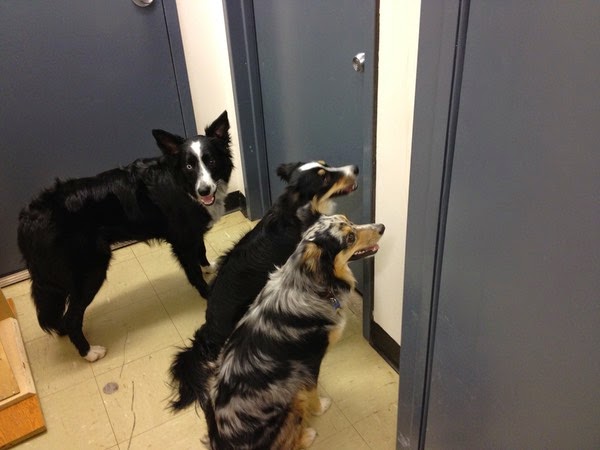
Note: The Dalhousie University Canid Behaviour Research Team uses force-free, positive methods of training dogs for olfactory detection, discrimination, identification, tracking and trailing. All dogs are pets volunteered by their owners and are selected for temperament, trainability, scent abilities, and play drive (i.e., “work” drive). For that reason, 95% of our volunteers are border collies or border collie mixes.
* Domjan writes in fact, in this popular textbook (p. 302, 2003, 5th edition) “On the basis of a few experiments Thorndike (1932) and Skinner (1938, 1953) concluded that punishment was not a very effective method for controlling behavior and that it had only temporary effects at best (see also Estes, 1944). This claim was not seriously challenged until the 1960’s, when punishment processes began to be investigated more extensively (Azrin & Holz, 1966; Campbell & Church, 1969; Church, 1963; Solomon, 1964). We now know that punishment can be an effective technique for modifying behavior (Dinsmoor, 1998).”
Mech L.D. (1999). Alpha status, dominance, and division of labor in wolf packs, Canadian Journal of Zoology, 77 (8) 1196-1203. DOI: http://dx.doi.org/10.1139/z99-099